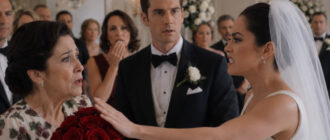
On the morning of my wedding, everything looked perfect: white roses, golden lights, polished marble, soft music, and hundreds of smiling guests. I should have felt proud, but something inside me was strangely uneasy.
My father, Victor Hale, adjusted my tie and told me I was ready to begin a new chapter. His voice was warm, yet his eyes looked tired, as if he was carrying something he had never said aloud.
The ceremony was held in the grand ballroom of the Aurelia Hotel. Everyone admired Clara, my bride, and called us the perfect match. I almost believed it too.
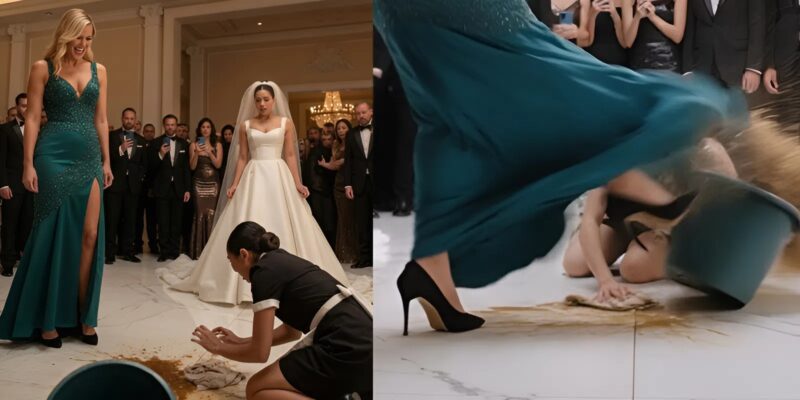
Then, before the ceremony began, a glass of sparkling juice spilled onto the marble floor. A young woman in a simple cleaning uniform hurried over with a cloth and bucket. Most guests ignored her, but when she looked up, I froze.
Her face was unfamiliar, yet somehow painfully familiar. Her eyes, her quiet expression, even the small curve near her eyebrow touched a memory I could not explain. It felt like recognizing a song from childhood without knowing where I had first heard it.
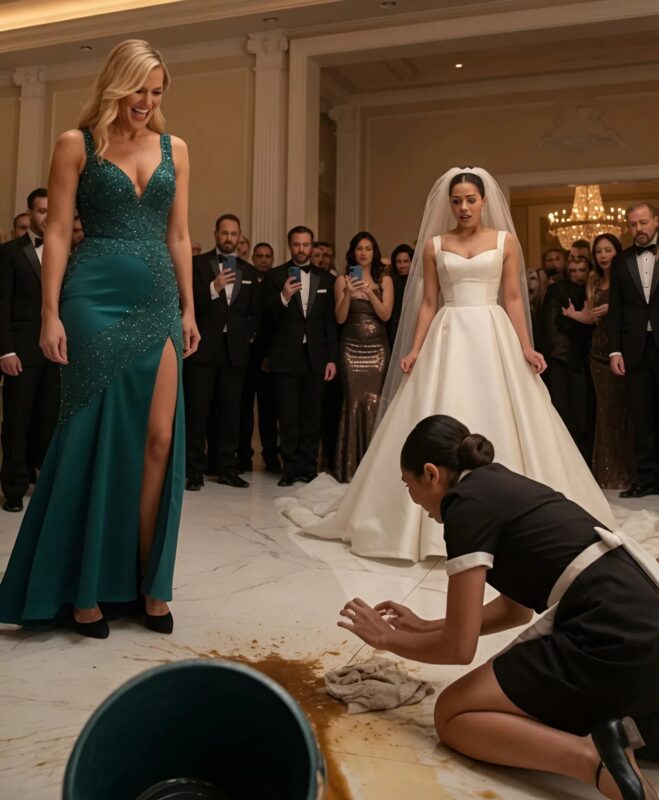
I tried to look away, but my eyes returned to her again and again. She lowered her head quickly when she noticed me watching. Her hands moved faster over the floor, and I saw that she was nervous. Not clumsy, not careless, just nervous in a room full of people who had already decided she did not matter. Something about that bothered me more than it should have. I had been raised to be polite, but politeness can be distant. That day, for the first time, I felt the difference between manners and kindness. 🤍
Clara touched my arm and whispered that we should take our places, but I could not stop looking at the young maid. When her cleaning cap slipped, I saw her face more clearly — the same eyes, the same quiet expression, the same features I had once seen in an old photograph hidden in my father’s study.
Years earlier, I had found a small wooden box in his office. Inside were letters, photographs, and one faded picture of my father as a young man standing beside a kind-eyed woman who held a little girl. When I asked about it, my father quietly closed the box and said it belonged to a chapter from the past.
After that, the box disappeared, and no one ever spoke of it again. I only knew my father had been married once before, and the rest was treated like a private family secret.
Now, on my wedding day, that memory returned with painful clarity. The maid was older than the child in the photograph, but her eyes, her strength, and even the curve of her eyebrow were the same.
As the ceremony began, I barely heard a word. Every mention of family felt like a question. My gaze kept returning to her, standing quietly near the side entrance, unaware that her face had opened a door I thought had been closed forever.
When the officiant asked us to step forward, I knew I could not continue without knowing the truth. I had to ask her name.
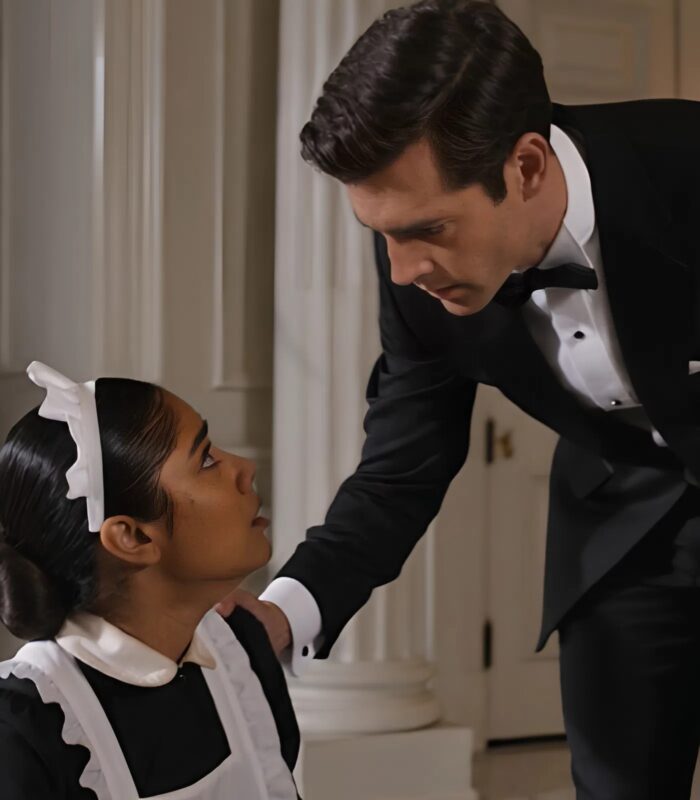
I turned slightly and asked the hotel coordinator to bring the young woman closer. The coordinator blinked in surprise, then obeyed. A ripple of curiosity moved through the guests. Clara’s smile faded a little. My father looked up. The young woman approached slowly, clearly uncomfortable with the attention. She stopped a few steps away and lowered her eyes. I tried to speak gently, because I did not want to frighten her or embarrass her. “What is your name?” I asked. 🌹
She swallowed and answered, “My name is Nora.” The name entered the room quietly, but to me it sounded like a bell. Nora. In the photograph, on the back of the picture, written in my father’s handwriting, there had been two words: Little Nora. My hands became cold. I looked at my father again. His face had changed. Not dramatically, not loudly, but enough. His eyes widened, and every bit of color seemed to leave him at once. He knew the name. He knew her face. He knew. 🧩
Clara whispered my name, asking what was happening. I could not answer her yet. I stepped closer to Nora and asked, “Did your mother’s name happen to be Liana?” The room became so quiet that I could hear the distant sound of a spoon being set down on a table. Nora lifted her eyes for the first time. They filled with emotion, but she held herself with dignity. “Yes,” she said softly. “My mother was Liana Vale.” 🕊️
My father stood. No one spoke. He walked toward us slowly, as if each step required courage. I had seen him negotiate impossible deals with calm confidence. I had seen him face crowds without a tremble in his voice. But I had never seen him look as human as he did in that moment. When he stopped in front of Nora, he whispered her name, not as a question, but as a memory returning home. “Nora.” 🌧️

She looked at him carefully. “Mr. Hale,” she said, polite and distant. That distance seemed to touch him deeply. He opened his mouth, closed it, then tried again. “I searched for you,” he said. “For years. I was told you and your mother had chosen a quiet life away from this family. I was told you did not want contact.” Nora’s eyes softened, but she did not step forward. “My mother told me you sent letters,” she replied. “But they stopped when I was little.” 📬
A murmur moved through the ballroom. My father looked confused, then saddened. My aunt Maribel, who had always managed family matters with perfect control, suddenly looked down at her hands. I noticed it. My father noticed it too. A hidden story was rising between us, not with blame, but with the ache of years lost to decisions made by others. I did not need every detail to understand the truth: two people had been kept apart by silence, pride, and fear of scandal. 🪞
I turned to Nora, my voice trembling. “I think you are my sister.” The whole ballroom seemed to fade away. Nora looked at me with tears in her eyes and whispered, “I always wondered if I had a brother. My mother kept one photograph of you as a baby.”
Clara surprised me most. Instead of stepping away in anger, she walked to Nora and gently placed her ivory shawl around her shoulders. “Family should not have to stand in the corner,” she said softly.
My father could barely speak. Nora explained that she had only come to work, not to disturb anyone. But then she pulled a small envelope from her uniform pocket. Her mother had asked her to give it to my father if they ever met.
Inside was a note saying that Nora had always been loved. There was also a photograph: my father holding baby Nora, while a tiny boy slept beside them. That boy was me.
At that moment, I understood the truth. I had not only found a sister on my wedding day. I had found the missing part of my own life.
Clara and I still married that day, but first I asked Nora to stand with my family. And from then on, my wedding was not remembered for the flowers or music, but for the quiet young woman everyone had ignored — the woman who turned out to be my sister.