I used to believe the hardest part of high school was earning good grades while pretending not to care what everyone thought of me. I was wrong. The hardest part was realizing how easily an ordinary person could become part of someone else’s painful memory simply by remaining silent. My name is Mason Reid, and one spring afternoon taught me that doing nothing can still become a choice. 🌤️
Our school courtyard was crowded during lunch, especially near the old stone steps behind the gym. That was where the popular students gathered, where jokes traveled quickly, and where everyone seemed to understand an invisible set of rules. You had to laugh at the right moment, wear the right clothes, and never appear uncertain. I followed those rules because blending in felt safer than standing apart. 🎒
That afternoon, I was sitting beside my friend Callum when I noticed a quiet girl named Nora Vale walking toward the lowest step. She had short dark curls, a faded green jacket, and a canvas bag covered with tiny embroidered stars. She usually ate alone while sketching in a notebook. I knew almost nothing about her except that she transferred to our school halfway through the year. ✏️
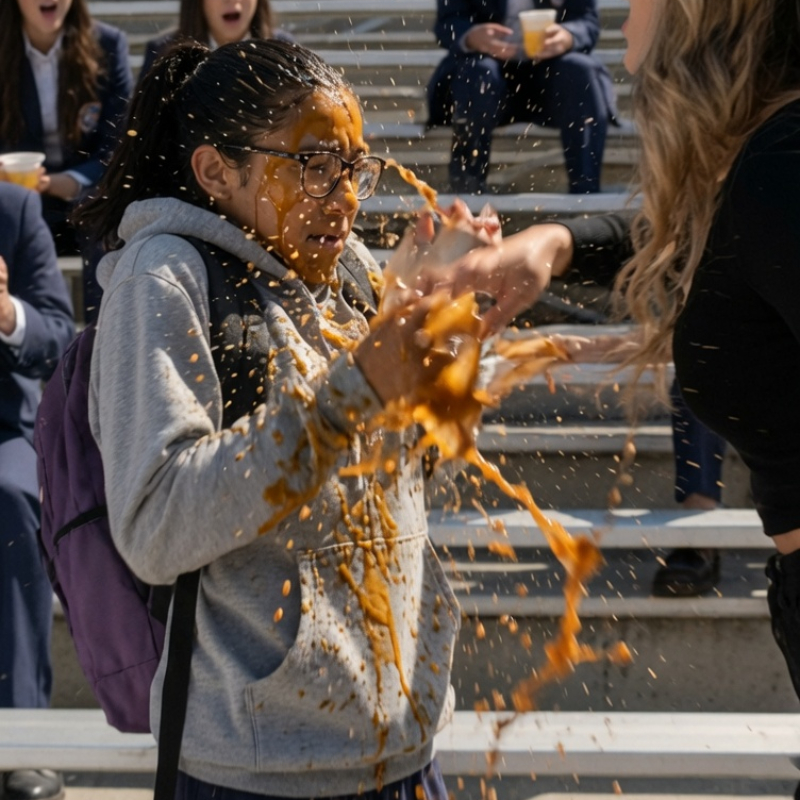
Nora carried a small container of homemade pasta and a paper bag with an apple inside. She sat down several feet away from us and opened her sketchbook beside her lunch. She looked peaceful, almost invisible among the louder students. I remember thinking she seemed perfectly comfortable by herself, although I later learned that appearing calm and feeling comfortable are not always the same thing. 🍎
Then Tessa Marlow arrived with two friends. Tessa was confident, stylish, and always surrounded by people who wanted her approval. She noticed Nora’s drawings and leaned closer, asking to see them. Nora politely closed the sketchbook and said they were unfinished. Tessa smiled, but something in her expression suggested she had expected a different answer. Everyone nearby began paying attention. 👀
“Why hide them?” Tessa asked. “We might like them.”
Nora held the notebook against her chest and quietly replied, “I’d rather keep them private.”
It was a reasonable answer, yet several students exchanged amused looks. Tessa reached toward the notebook, and Nora moved it away. During that awkward moment, Nora’s lunch container slipped from her lap and landed open beside the steps. 🍝
Nothing dramatic happened. No one shouted, and no one moved quickly. The food simply scattered across the pavement while Nora stared down at it. Tessa lifted her hands and said, “I barely touched anything.” One of her friends laughed nervously. I looked at Callum, expecting him to stand. He looked at me with the same expectation. Neither of us moved. 🍃
Nora knelt and began gathering the pieces of her lunch with a napkin. Her face remained calm, but her fingers shook slightly. She wiped a small stain from her sleeve and kept her eyes fixed on the ground. I could have helped. I was close enough to reach the container without even leaving my seat. Instead, I remained where I was because I did not want everyone looking at me. 😔
That moment has stayed with me more clearly than many larger events from my school years. I remember the sunlight on the pavement, the sound of someone closing a locker inside the gym, and the uncomfortable silence around us. Most of all, I remember telling myself that it was not my responsibility. It was the kind of excuse that sounds reasonable until you hear it afterward. 🕊️
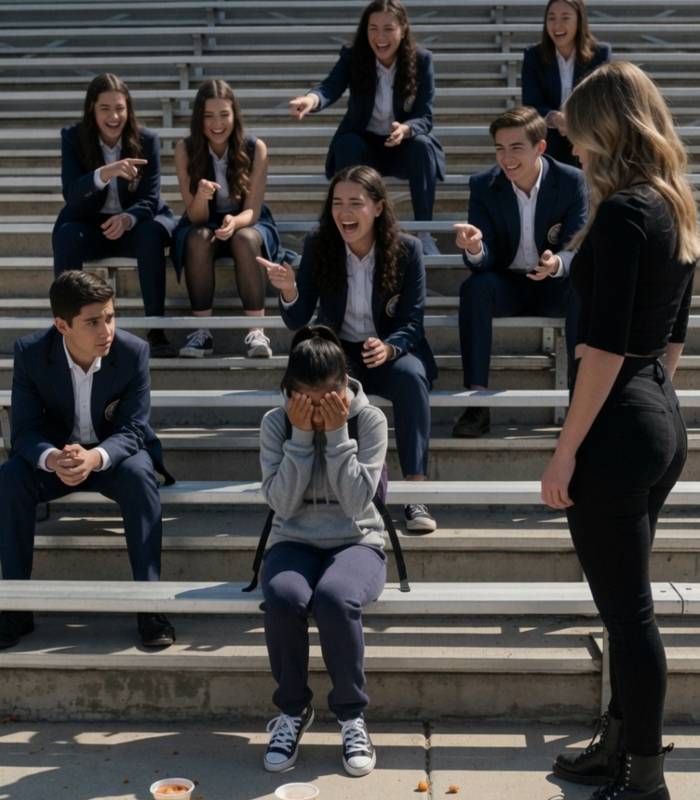
Nora finally sat on the lowest step, holding the empty container in her lap. Tessa turned away and began speaking to her friends as though nothing important had happened. A few students returned to their conversations. I thought the moment was ending until the courtyard became quiet again for a completely different reason. Someone was walking toward us from the administration building. 👣
It was Principal Selene Ward, a composed woman known for listening more than she spoke. She wore a navy suit, carried a slim folder, and rarely needed to raise her voice. When students noticed her, they immediately straightened. Principal Ward walked past Tessa without addressing her and stopped beside Nora. Then she offered Nora a clean cloth and quietly asked whether she needed water. 🤍
Nora nodded but did not look up. Principal Ward waited beside her without rushing. That patience made the rest of us feel even more uncomfortable. She did not accuse anyone or demand an explanation. Instead, she turned toward the students on the steps and asked a simple question: “How many people noticed that someone needed help?” Almost every hand slowly rose. 🌱
Then she asked, “How many people offered it?”
No one moved.
Principal Ward looked across the courtyard, not with anger but with unmistakable disappointment. She explained that kindness was not only about avoiding unkind actions. It was also about recognizing when another person felt alone and choosing not to walk past. Her words were calm, which somehow made them more difficult to ignore. 📖
Tessa stepped forward and insisted the lunch had fallen accidentally. Principal Ward nodded and said accidents could happen, but what followed an accident revealed far more than the accident itself. She asked why no one helped Nora gather her things and why several students treated her discomfort as entertainment. For the first time, I understood that the lesson was not meant only for Tessa. 🧭
The following morning, Principal Ward announced that every student directly involved—including those who had encouraged the situation or watched silently—would complete four Saturdays of community service. We would restore the neglected school garden, organize donated books, prepare art materials for younger students, and help at the neighborhood learning center. My name was included. I felt embarrassed, but I knew she was right. 🌳
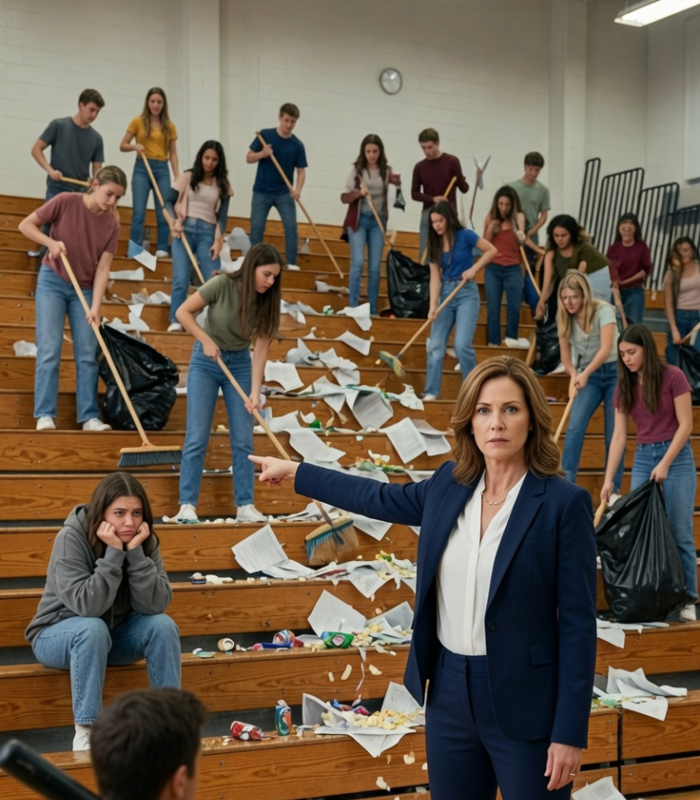
Our first Saturday was awkward. Tessa barely spoke, Callum complained quietly, and I focused on pulling weeds so I would not have to make conversation. Nora was not there. Principal Ward explained that community work was meant for those who needed to reflect, not for the person who had been left uncomfortable. Nora had been invited to join the regional student art program instead. 🎨
Over the next few weeks, something unexpected happened. The community work stopped feeling like a consequence and began feeling useful. We painted shelves, sorted hundreds of books, and created a reading corner filled with cushions and handmade signs. Younger children thanked us with such enthusiasm that even Tessa began arriving early. She turned out to be remarkably patient when helping them choose stories. 📚
During our final Saturday, we worked in the school garden beneath a row of newly planted trees. Tessa admitted she had approached Nora because she genuinely admired her drawings but felt embarrassed when Nora refused to show them. Instead of accepting the boundary, she tried to regain everyone’s attention. She did not excuse herself. She simply said, “I made her feel small because I felt small.” 🌿
I told her that my silence had also contributed. Callum admitted the same thing. That afternoon, we wrote Nora a letter—not a dramatic apology designed to make ourselves feel better, but a promise to behave differently. We told her she did not owe us forgiveness or friendship. We only wanted her to know that we finally understood why our choices had mattered. ✉️
Nora did not immediately become our friend. She continued sitting with the art club and kept a respectful distance. Principal Ward reminded us that improving our behavior did not mean Nora owed us closeness or trust. 🌸

By the end of the school year, the atmosphere had changed. Students became more thoughtful, quieter classmates were included, and several of us continued volunteering even after our community work had ended. 🌈
At the final assembly, Nora’s artwork was displayed on the screen. It showed a crowded room with one empty chair. She explained that the chair represented every person who had ever felt unnoticed. 🖼️
Then Principal Ward stepped beside her and revealed the truth: Nora was her daughter. They had kept it private because Nora did not want anyone treating her differently because of her mother’s position. 💙
Nora explained that she wanted us to learn kindness before knowing who she was. The room fell silent as everyone understood the real lesson. 🤝
Years later, I still remember the message beneath her drawing: Notice the empty seat before asking who should be sitting there. 🏡
The greatest surprise was not that Nora was the principal’s daughter. It was that her mother trusted us to become better without using her position. Real kindness appears when no important person is watching—and we still choose to help. ❤️