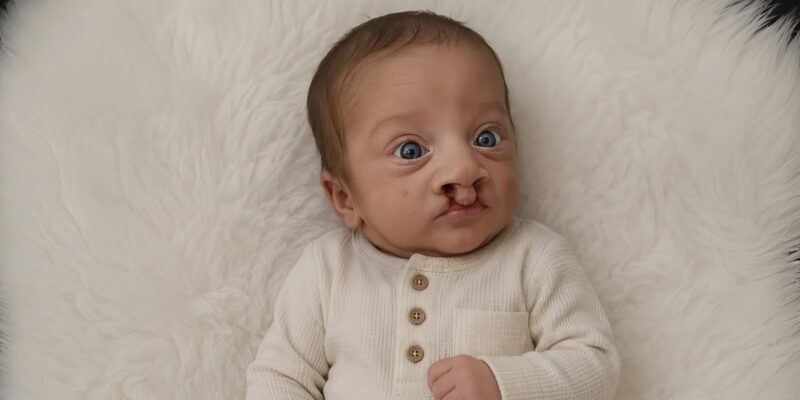
When my son was born, the room became unusually quiet, not in a frightening way, but in a way that made every sound feel softer. I remember holding him against my chest and looking at his tiny face, his wide blue eyes, his little fingers curled like rose petals, and the small difference around his nose and upper lip that made the nurses glance at me gently before speaking. I did not see something “wrong.” I saw my child. My whole world was lying in my arms, breathing softly, wrapped in a yellow blanket with tiny stars on it. 🌟
The doctor explained everything carefully. He said my baby had been born with a facial difference, something that could often be improved with special care and surgery. I nodded, though my mind was far away. I was not thinking about medical words or future appointments. I was thinking about how my son’s eyes followed my voice, how he calmed when I touched his cheek, and how his tiny mouth searched for comfort. In that moment, I made myself one quiet promise: he would never feel unloved because of the way he looked. 🤍

We named him Elias. It was my grandmother’s favorite name, and she used to say it meant light in our family. During the first months, I learned how to feed him slowly, how to hold him at the right angle, how to understand the little sounds he made before anyone else could. Some days were exhausting, but there was also a strange beauty in our routine. While other mothers compared sleeping schedules and baby clothes, I celebrated every small step: one calmer feeding, one peaceful nap, one new smile that seemed to brighten the whole room. 🍼
People reacted in different ways. Some were kind, some were curious, and a few stared longer than they should have. At first, those looks followed me everywhere: in the market, at the clinic, on the bus. I would pull Elias closer, pretending not to notice, while my heart quietly learned how strong it needed to become. But Elias never hid from the world. He looked at everyone with those huge curious eyes, as if he was the one studying them, not the other way around. Slowly, I understood something important: his face was not asking for pity; it was asking for love. 👀
When Elias turned one, doctors told us again that surgery could help, but life was not simple for us. We lived far from the city, the waiting lists were long, and every visit required money, time, and courage I did not always have. I used to feel guilty at night, sitting beside his crib while he slept with one hand tucked under his cheek. I would whisper apologies he could not understand, promising that I was trying. But every morning he woke up smiling at me, as if he had already forgiven worries I had not even spoken aloud. 🌙
By the time he was three, Elias had become the most unforgettable child in our neighborhood. He wore little denim shirts, soft brown pants, and shoes he always tried to put on the wrong feet. His hair had grown into warm curls, and his blue eyes still carried that surprised sparkle from his baby days. Children noticed his nose and lip at first, but then they noticed his laugh, his gentle hands, and the way he shared his wooden toy car with anyone who looked lonely. Within minutes, they were not asking questions anymore. They were running after him across the garden. 🚗
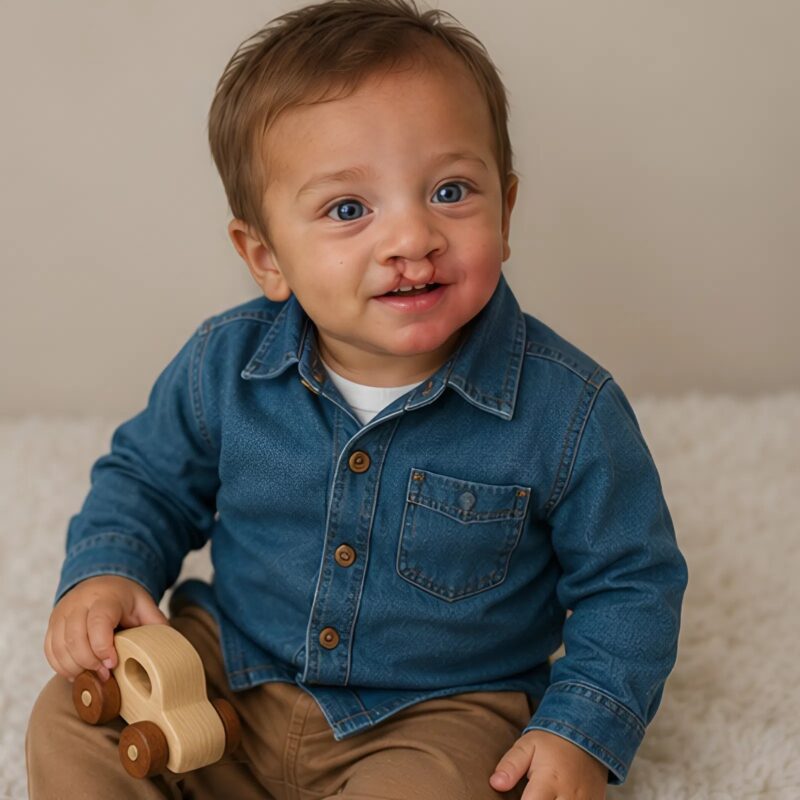
One afternoon at the playground, I saw a little girl point at Elias and whisper something to her mother. My body tightened, ready to protect him before a single word could reach him. But then Elias walked straight to the girl, placed his toy car in her palm, and said, “You can play too.” The girl smiled, and just like that, the moment changed. Her mother looked at me with tears in her eyes and said, “Your son has the kindest face I have ever seen.” I carried those words home like a small treasure. 🌼
School was the part I feared most. I imagined questions, awkward silence, and moments when he might come home with sadness tucked behind his smile. On his first day, I dressed him in a clean green sweater and combed his hair twice because my hands needed something to do. He stood by the door with his little backpack and asked, “Mama, will they like me?” I bent down, touched his cheek, and said, “They will know you, and then they will love you.” I hoped my voice sounded braver than I felt. 🎒
That afternoon, I arrived early to pick him up. I stood outside the classroom door and heard laughter inside. For one second, my heart jumped, but then I saw Elias standing in the middle of a small circle of children. He was telling them a story about a moon that forgot where it belonged and a star that helped it find the sky again. His words were simple, but his face was glowing. The children listened as if he was sharing a secret map. His teacher whispered to me, “He made everyone feel included today.” ✨
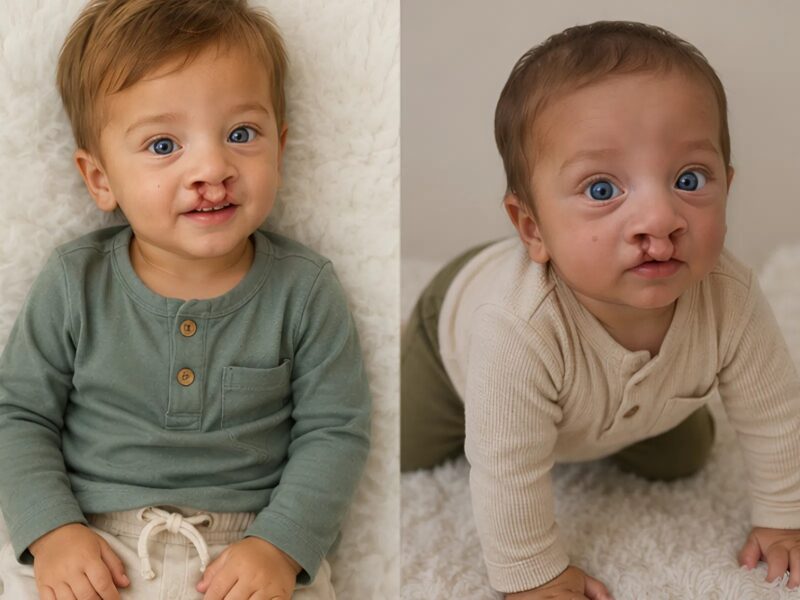
Years passed, and Elias grew into the kind of boy people remembered after meeting him once. He still had the same facial difference because surgery had not yet happened, but it no longer felt like the center of his story. He loved drawing birds, collecting smooth stones, and choosing his own clothes with serious attention. Sometimes he wore a blue denim shirt, sometimes a striped sweater, and sometimes mismatched socks because he said colors should have friends. Everywhere we went, someone greeted him by name. Not because of his difference, but because of his warmth. 🧦
One evening, our town organized a small children’s art exhibition. Elias had drawn a picture of himself as a little prince standing under a sky full of stars. I noticed he had drawn his face exactly as it was, with no attempt to change the shape of his nose or lip. Under the drawing, he had written in careful letters: “This is me when I am happy.” I stood there staring at those words while people gathered around the picture. No one spoke loudly. They simply looked, smiled, and understood something without needing explanation. 🎨
A woman I did not know approached me after the exhibition. She said she worked with children and families who sometimes felt alone because their little ones looked different. She asked if Elias would allow his drawing to be shared in a support booklet for parents. I looked at him, unsure what to say. He tilted his head and asked, “Will it help babies like me?” The woman nodded. Elias smiled and said, “Then yes.” In that moment, my son became more than my child; he became comfort for families he had never met. 📖
The unexpected twist came a few weeks later, when we received a letter from a mother in another town. She wrote that her newborn son had been born with a similar facial difference and that she had cried for days, not because she did not love him, but because she was afraid of the world. Then she saw Elias’s drawing and the sentence beneath it. “This is me when I am happy.” She wrote that for the first time, she looked at her baby and imagined not fear, but birthdays, school days, laughter, and love. 💌