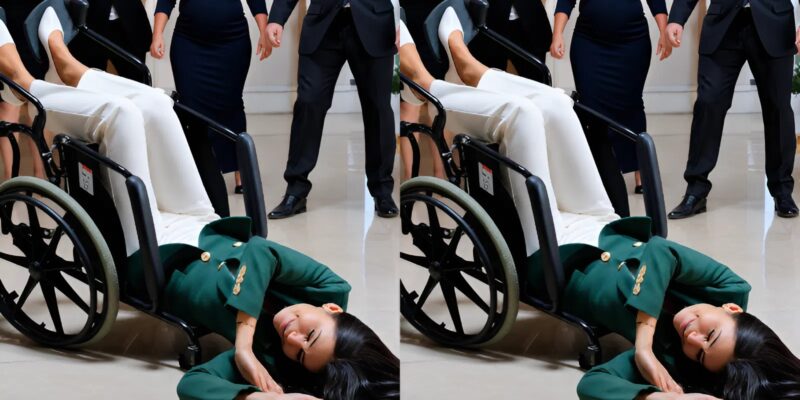
The marble floor was so polished that the chandeliers looked like they were floating beneath our feet, but all I could see was my own reflection trembling in it. I was sitting in my wheelchair near the entrance of the Harrington Gala, wearing my teal jacket and cream trousers, trying to breathe calmly while dozens of wealthy guests moved around me like I was part of the furniture. Then, in one sudden moment, my chair tipped sideways, my palm touched the cold floor, and every conversation in the golden lobby broke into whispers. 😔
For a few seconds, I could not move. Not because I was unable to, but because humiliation has a strange way of freezing the heart before the body. My small evening bag had slid across the marble, my hair had fallen over my face, and my right hand shook as I reached for the wheel that was still spinning beside me. Above me stood Celeste Varlow, the woman everyone in the city admired for her charity dinners and perfect white suits. Her voice cut through the room like polished ice: “Please remove her from the main hall.” 🕯️
I had seen that look before. Not from her, but from people who believed kindness was something they could display on stage while forgetting it in private rooms. Celeste looked down at me as if my presence had disturbed the beauty of her evening. Around us, guests in silk dresses and dark suits stepped back, unsure whether to help or pretend not to notice. A few lifted their phones, not openly, but low against their chests, as if even their curiosity needed to hide. 🌫️
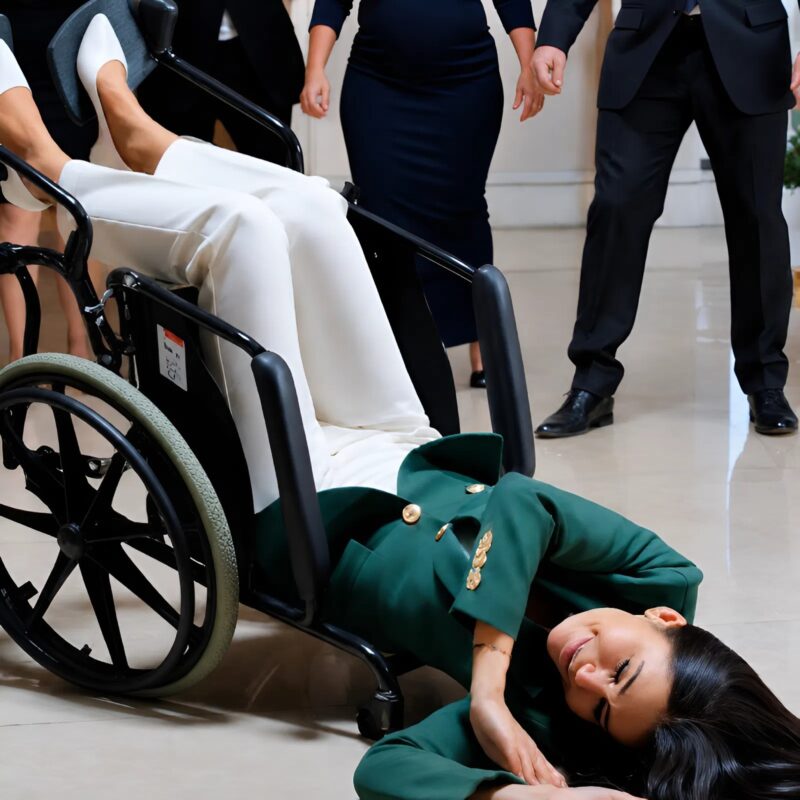
My cheeks burned, and I pressed my fingers against the marble to steady myself. I wanted to say something sharp, something brave, something that would make everyone understand that I was not an accident in that room. But my voice stayed behind my ribs. The lobby smelled of lilies, expensive perfume, and warm candle wax. It was a beautiful place, almost painfully beautiful, and that made the moment feel even lonelier. 🌹
Celeste leaned closer, her diamond necklace catching the light with every breath. “This is a private gathering,” she said, softly enough to sound graceful, loudly enough for the nearest guests to hear. “You should have used the side entrance.” That sentence landed harder than the fall. Not because it surprised me, but because I remembered another woman hearing almost the same words many years ago, in this very house, while carrying folded linens through a hallway no guest ever saw. 🥀
A young man from the event staff rushed toward me before anyone else moved. His name tag read Adrian. He set my chair upright with careful hands, then knelt beside me as if I were the only person in the room. “Easy,” he whispered. “Take your time. You are safe.” His kindness was quiet, but it filled the lobby more strongly than Celeste’s command. When he offered his arm, I held it, not because I needed to appear weak, but because sometimes accepting help is the bravest thing a person can do. 🤍
As Adrian helped me back into my chair, I noticed Celeste’s expression change from anger to irritation. She did not like that the room had stopped listening to her. She did not like that people were watching me, not as an inconvenience, but as a person. A woman near the staircase lowered her eyes. An older man cleared his throat. Someone whispered, “Who is she?” I looked down at my hands and smiled faintly, because that was the question I had waited years for them to ask. ✨

My mother, Maren, had worked in this mansion long before Celeste began hosting galas here. She knew every corner, every servant corridor, every window that caught morning light. She used to tell me the house had two faces: one for guests, filled with gold and music, and one for workers, filled with quiet steps and tired smiles. She never complained, not once. She only said, “A house remembers how people behave inside it.” 🏛️
When I was a child, I waited for her near the back garden gate because I was not allowed through the front doors. She would come out with tired eyes and a soft smile, smelling faintly of soap and lavender. Sometimes she brought me leftover pastries wrapped in a napkin. Sometimes she brought stories. She told me about grand parties, crystal glasses, velvet curtains, and people who forgot to say thank you. Then she would touch my cheek and say, “Promise me you will never measure yourself by the door someone tells you to use.” 🌙
Years passed. I studied, worked, failed, started again, and built a small design company from a rented room with one cracked window. I learned contracts, architecture, restoration, and how old buildings could be saved without erasing the people who had cared for them. My wheelchair became part of my rhythm, not my limitation. I moved through boardrooms, construction sites, and meetings where people first underestimated me, then quietly corrected themselves. Every step of my journey brought me closer to this house. 🗝️
Three months before the gala, the Harrington estate quietly went up for private sale. Most people assumed a hotel group would buy it, tear out its soul, and turn it into another luxury brand. I made an offer through my company, using every bit of patience and strategy I had gathered over the years. When the papers were finally signed, I sat alone in my office and cried—not from sadness, but because my mother’s old words came back to me: a house remembers. 📄
But I did not announce the purchase immediately. I wanted to walk—or rather, roll—through the front entrance before anyone knew. I wanted to see whether the house had changed, whether people had changed, whether elegance had finally learned humility. So I accepted Celeste’s invitation under my middle name, arrived without assistants, wore a simple teal jacket, and entered quietly. The staff greeted me with respect. The guests barely noticed me. Celeste noticed only enough to decide I did not belong. 🪞
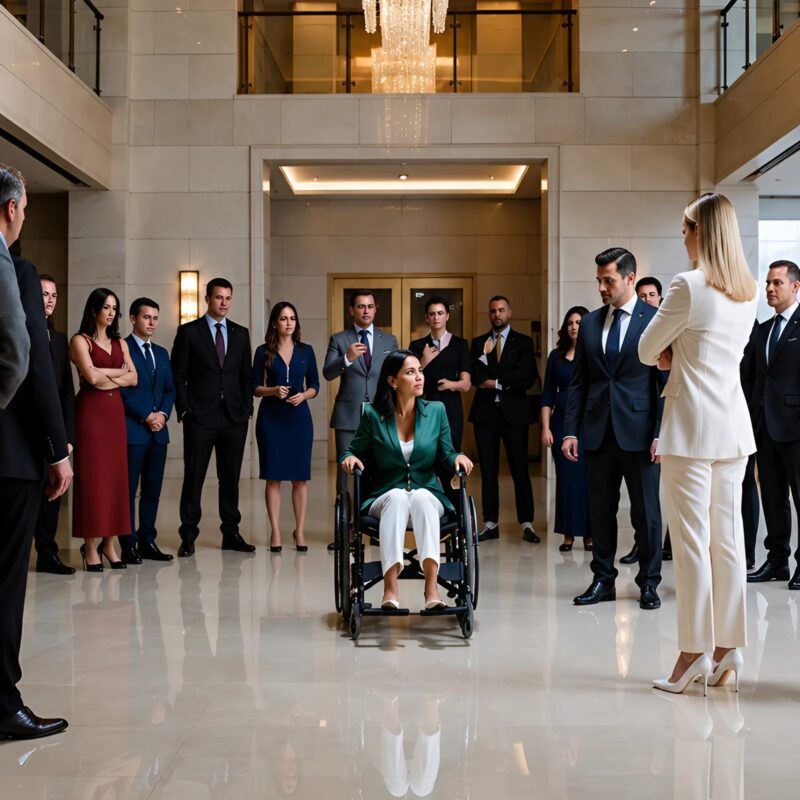
Now, sitting in my restored wheelchair in the center of the lobby, I lifted my eyes to her. The room was silent enough to hear the soft hum of the lights above us. Adrian stood beside me, still holding a leather folder he had brought from the office upstairs. He looked at me once, and I nodded. With careful dignity, he placed the folder on my lap. Celeste’s gaze dropped to the seal on the front. Her lips parted before she even read the first page. 💼
“This cannot be right,” she whispered. The confidence in her voice had thinned. I opened the folder slowly and turned the document so she could see the estate name, the transfer date, and my signature at the bottom. Not a nickname. Not a misunderstanding. My full legal name: Elara Maren Vale. Owner of the Harrington Estate and founder of Vale Heritage Trust. The guests leaned forward as if the marble itself had begun speaking. 🖋️
Celeste looked at me, then at the papers, then back at me. “I didn’t know who you were,” she said. Her words were small now, smaller than the apology she still had not offered. I rested my hands on the armrests and answered gently, because my mother had taught me that power did not need to shout. “You knew I was someone.” The sentence moved through the room like a bell, soft but impossible to ignore. 🔔
A few guests lowered their heads. One woman wiped her eyes. Adrian stood taller, and for the first time that evening, the staff members near the walls were not invisible. I turned my chair slightly and looked around the lobby my mother had once cleaned before sunrise. “This estate will no longer be a place where dignity depends on clothing, titles, or the door someone enters through,” I said. “Starting tonight, it becomes a foundation for workers’ families, accessibility projects, and young people who were told certain rooms were not meant for them.” 🌟
Celeste’s face lost its color. “You are replacing the gala?” she asked. I shook my head. “No. I am giving it a purpose.” Then I looked toward the grand staircase, where the portraits of old owners watched from gilded frames. “And there is one more thing.” Adrian opened the final page. The room waited. I smiled through the ache in my chest. “The main hall will be renamed the Maren Hall, after the woman who kept this house shining while others pretended not to see her.” 🕊️
For the first time that night, no one whispered. No one recorded. No one moved. Then one staff member began clapping—quietly at first, almost afraid of the sound. Another joined. Then another. Soon the applause filled the lobby, not loud like celebration, but deep like recognition. I looked down at the marble where my hand had touched the floor and realized something unexpected: I had not fallen in that house. I had returned to lift my mother’s name through the front door. 💫